Hotel Influencer Marketing: How to Work with Travel Influencers


Influencer marketing lets travelers see a hotel through someone else’s actual experience. Creators can show the room, breakfast, spa, location, and other details guests care about before booking. For hotels, this can mean reaching new audiences, getting useful content, and driving traffic or bookings.
But hotel influencer marketing needs more than a complimentary stay and a few posts. You need the right creator, clear terms, and a way to measure the result.
This guide explains how to set up and evaluate a hotel influencer campaign.
What is hotel influencer marketing?
Hotel influencer marketing is a collaboration between a hotel and a creator who shares the property or guest experience with their audience.
The creator might stay at the hotel, visit the spa or restaurant, attend an event, or produce content for Instagram, TikTok, YouTube, or a blog. The hotel may provide the stay, pay a fee, or combine both.
A typical campaign looks like this:
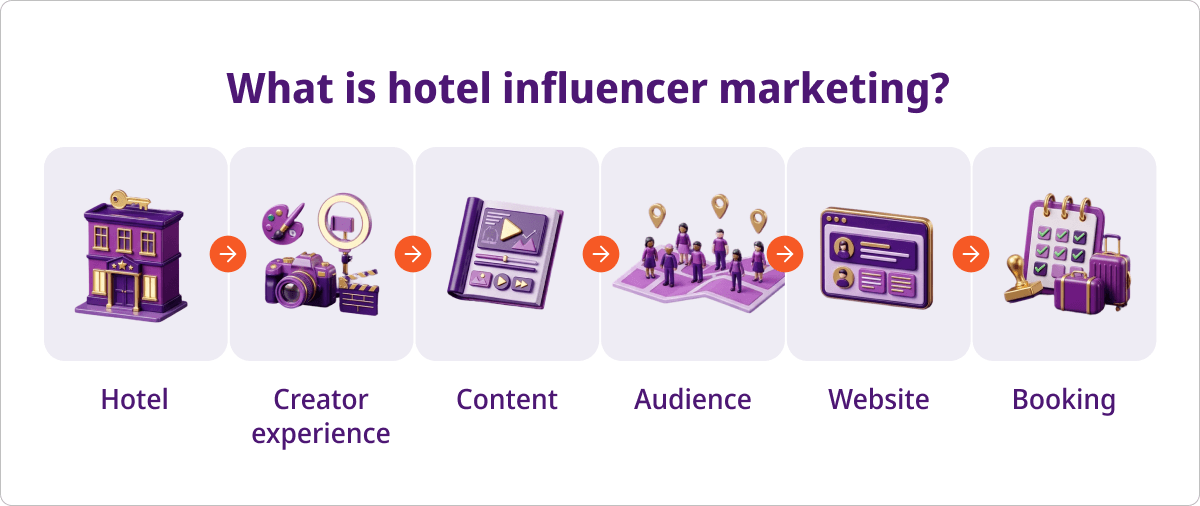
The campaign does not always need to drive direct bookings. It may be aimed at awareness, reaching a new market, or creating content for the hotel’s own channels.
Step 1. Decide what you want the campaign to achieve
Before choosing influencers, decide what you want the campaign to deliver. That goal will influence the creator you choose, the content you ask for, and how you measure the result.
| Hotel need | Campaign goal |
|---|---|
| New hotel or renovation | Build awareness |
| Weak demand from a target market | Reach travelers in that market |
| Need more direct sales | Generate website traffic and bookings |
| Limited in-house content | Produce reusable photos and videos |
| New spa, restaurant, or package | Support the launch |
For example, if you want bookings from a particular country, audience geography matters more than total follower count. If you mainly need new video content, the creator’s production quality and the rights to reuse that content may matter more than how many people click through to the website.
One campaign can support several goals, but it helps to have one clear priority.
Step 2. Decide what type of creator you need
There is no universally “best” type of influencer for a hotel. The right choice depends on who you want to reach and what you are promoting.
Travel creators
Travel creators make sense when the stay or destination itself is the story. They are a good fit for resorts, city breaks, destination campaigns, and hotels trying to reach travelers outside their home market.
Travel is still a broad category, though. For example, a creator focused on budget backpacking may be a poor match for a luxury resort, even with a large audience.
Local creators
Don’t overlook creators based close to the hotel. They can be particularly useful for restaurants, spas, rooftop bars, weddings, events, and short domestic stays. If you are trying to sell a weekend package to people who can reach the hotel by car, a strong local audience may be much more useful than international reach.
Niche creators
Sometimes the niche matters more than travel expertise. A family resort might work with a parenting creator who regularly travels with children. A wellness hotel might be better matched with a yoga or wellness creator.
Micro-influencers
A hotel micro-influencer has a smaller audience than a major creator, but smaller is not necessarily a disadvantage. If most of those followers live in a market your hotel wants to reach and are interested in the right kind of travel, the collaboration can be highly relevant.
Step 3. Check whether their audience can actually become your guests
Once you find a potential hotel social media influencer, look beyond the profile itself. A creator may have beautiful travel content and strong engagement, but that doesn’t mean their followers are right for your hotel.
Check where the audience is based, what kind of travel they are interested in, and whether the hotel fits their typical price point.
For example, a creator with 35,000 followers mostly based in your target market may be more valuable than someone with 500,000 followers spread across countries where your hotel has little demand.
Also look at how the audience behaves. Do comments look genuine? Do followers ask questions about the destination or accommodation? Does the creator regularly generate meaningful discussion, or are most comments generic?
For a larger collaboration, ask for a media kit or recent platform analytics. Audience geography, age, reach, Story views, average video performance, and previous campaign results can tell you much more than follower count alone.
Also watch for obvious red flags. Sudden follower spikes, very low Story views compared with follower count, or repetitive generic comments are reasons to look more closely before agreeing to a partnership.
Step 4. Choose the collaboration model
A travel influencer hotel collaboration can be structured in different ways.
| Model | How it works |
|---|---|
| Hosted stay | The hotel provides accommodation or an experience in exchange for agreed content. |
| Paid partnership | The creator receives a fee for specific deliverables. |
| Hosted stay + fee | The hotel provides the stay and also pays for the content. |
| Performance-based | Compensation is linked to clicks, bookings, or promo code use. |
| Long-term partnership | The hotel works with the same creator across several campaigns or stays. |
A hosted stay can work well with smaller creators, but it is not free marketing. The room, meals, spa access, transfers, and staff time all have a cost.
Established creators may expect both accommodation and a fee, especially when the campaign includes several deliverables, production work, or usage rights.
Performance-based models can be useful when bookings are one of the main goals. A unique promo code or trackable link makes it easier to connect the campaign with actual results.
A hotel blogger partnership or creator collaboration can also continue beyond one stay. If a creator consistently brings relevant traffic or produces strong content, it may make sense to work with them again.
Step 5. Agree on the details before confirming the stay
Don’t rely on a few messages saying that the creator will “post something about the hotel.” Before the stay is confirmed, both sides should be clear on the main terms.
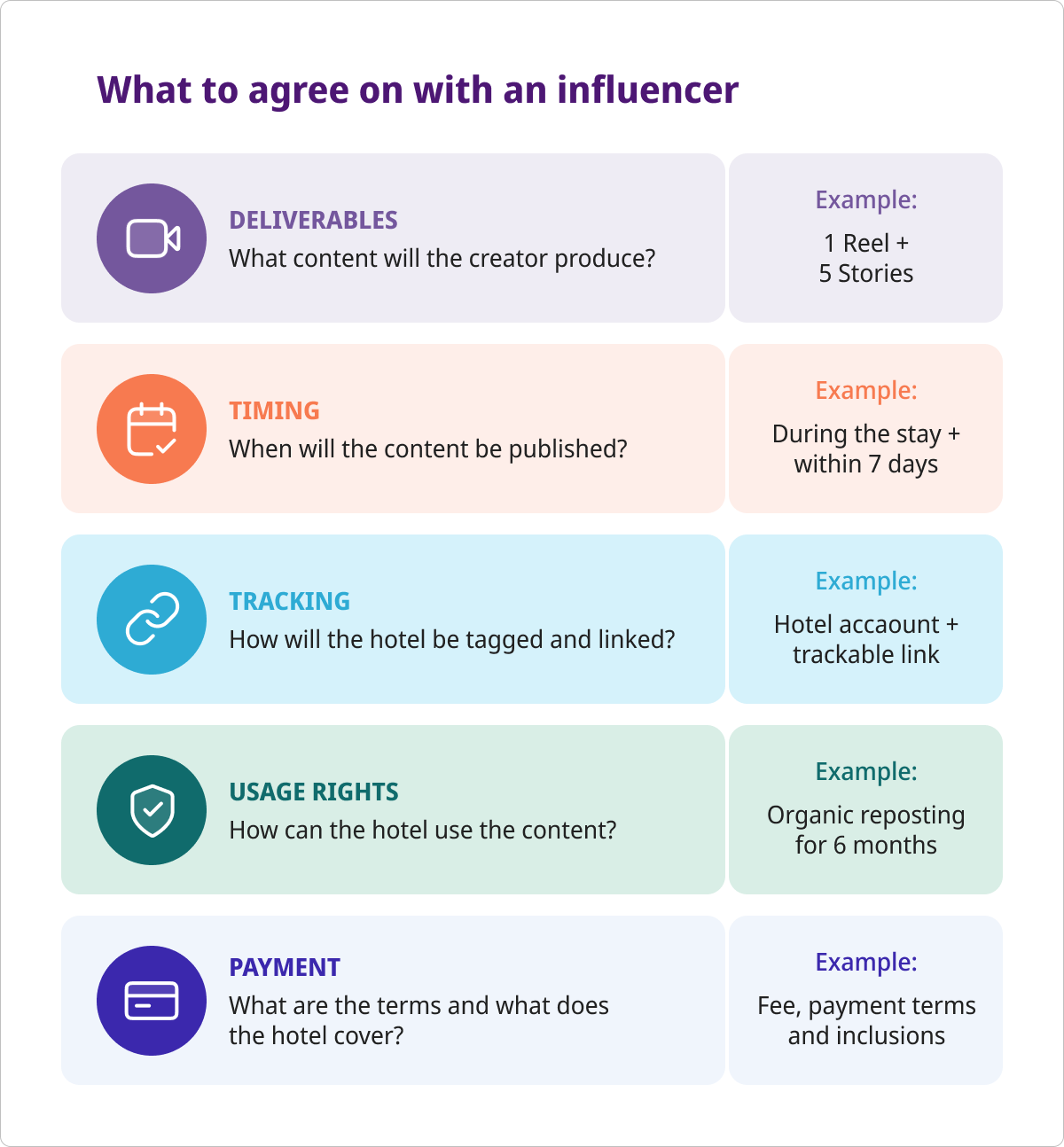
Start with the deliverables. Agree on what the creator will publish, on which platforms, and when the content should go live. If the campaign is meant to drive traffic or bookings, decide how it will be tracked. That may be a trackable link, promo code, or dedicated landing page.
Usage rights are also important. Permission to repost a Reel on social media doesn’t automatically mean the hotel can use it on the website, in email campaigns, or in paid ads. If you need broader rights, agree on them in advance.
Finally, confirm payment terms and what the hotel will cover during the stay, such as accommodation, meals, spa access, transfers, or other services.
Put these terms in writing, especially for paid or high-value collaborations.
Step 6. Give the creator a useful brief, not a script
The creator needs enough information to represent the hotel accurately, but the content should still feel like their own. Keep the brief focused on what matters: the campaign goal, the audience, the key experience or offer, important dates, and any details that must be correct.
For example, if you are promoting a family package, explain what it includes and which facilities are most relevant for families. If the campaign targets a specific country, highlight the details that matter for that market.
Avoid scripting the post line by line. Creators know how to speak to their audience, and overly controlled content often ends up sounding like an ad. Give them the facts and the direction, then leave room for their own style.
Make sure the stay itself supports the campaign too. If you’re promoting a wellness weekend, the creator should be able to experience the spa, relevant dining options, and other parts of the package. Before arrival, check practical details that could affect the content, such as room readiness, restaurant reservations, spa appointments, or filming permissions.
Step 7. Make the campaign trackable
If traffic or bookings are part of the goal, decide how you will track them before the campaign goes live. A simple path might look like this:
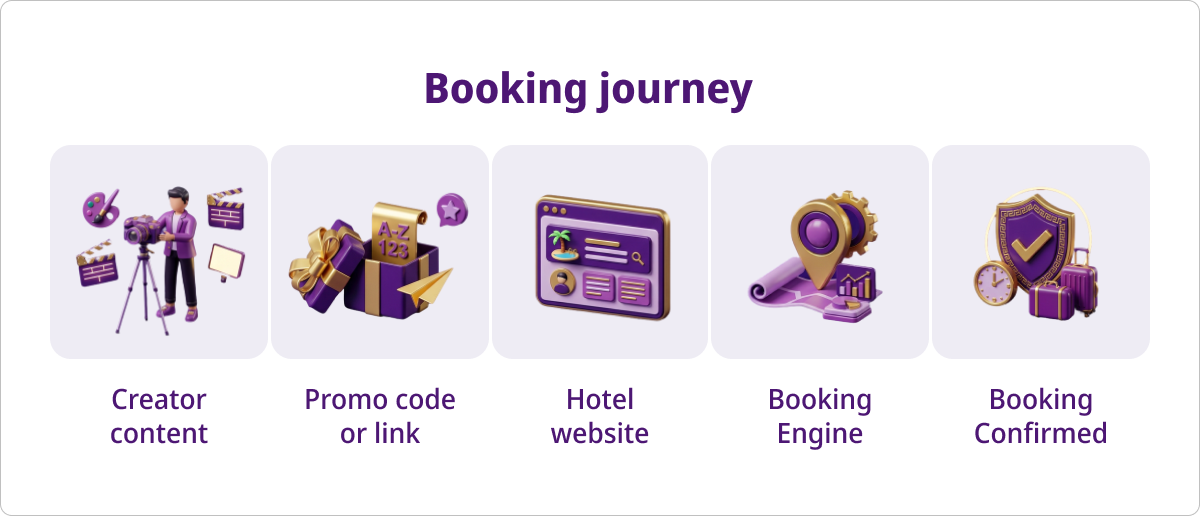
Useful tracking options include UTM links, unique promo codes, campaign landing pages, and booking engine analytics.
Example: Kass Land Resort
Kass Land Resort in Georgia used influencer marketing to grow awareness and bookings from Israel before the summer season. The hotel partnered with a well-known Israeli influencer, who invited other creators to experience the resort and share their stays on Instagram and Facebook.
The hotel created unique promo codes in Exely Booking Engine. Followers received a special discount, while the hotel could see how many bookings came directly from the influencer campaign.
Over six months, Kass Land recorded 122,819 website visits and 936 bookings.
This case is useful because the hotel didn’t stop at reach and engagement. It connected influencer activity with an actual booking mechanism and measured the result.
Step 8. Measure the result against the original goal
Once the campaign is trackable, you can compare what happened with the objective you set at the start. If the goal was awareness, reach and views matter. If the goal was bookings, look further down the funnel.
| Goal | What to measure |
|---|---|
| Awareness | Reach, impressions, video views |
| Engagement | Saves, shares, comments |
| Traffic | Website visits, link clicks |
| Bookings | Reservations, revenue, promo code use |
| Content production | Number and quality of reusable assets |
Compare the outcome with the full cost of the collaboration, including the creator fee and anything the hotel provided as part of the stay. This will help you decide whether to repeat the partnership, change the format, or try a different creator next time.
Common hotel influencer marketing mistakes
Even a well-planned campaign can lose value because of a few practical mistakes. Most of them happen before the creator publishes anything, so they are easier to prevent than to fix later. A few points deserve extra attention:
Choosing creators by follower count
A large following can look impressive, but it says little about whether those followers are potential guests. Audience fit should come first.
Accepting vague promises of “exposure”
Know what the hotel will receive before agreeing to a hosted stay or payment. “Several posts” is not a clear deliverable.
Forgetting content rights
Don’t assume the hotel can use creator photos and videos wherever it wants. Agree on reposting, website use, and paid advertising rights in advance.
Controlling the content too closely
The creator should understand the brief, but the content still needs to feel natural for their audience. If it reads exactly like the hotel’s own advertising, much of the value of the partnership disappears.
Hotel influencer outreach example
Once you have a shortlist, the next step is to contact the creator. Start with the channel they use for business requests. Many creators list an email address in their bio, profile, media kit, or website. If there’s no business email, a direct message on Instagram or TikTok can work for the first contact.
For paid or more complex collaborations, email is usually easier because you can keep dates, rates, deliverables, and attachments in one thread. A DM works well as a short introduction or to ask where the creator prefers to receive partnership requests.
Keep the first message short and specific. You don’t need to send the full brief immediately. Explain who you are, why you chose this creator, what kind of collaboration you have in mind, and ask for the information you need to continue.
Hi [Name],
We’re [Hotel], a [short description] in [destination]. We’ve been following your content about [specific topic] and think your audience could be a good fit for our property.
We’d like to discuss a [hosted stay / paid collaboration] around [campaign or dates]. If you’re interested, could you share your media kit, audience geography, and rates?
Avoid sending the same generic message to dozens of creators. A specific reference to their content makes it clear why you are contacting them rather than simply sending a mass partnership request.
Frequently Asked Questions (FAQ) about hotel influencer marketing
-
How far in advance should hotels contact influencers?
For a planned campaign, several weeks is a practical minimum. For peak travel periods, international trips, or larger creators, start earlier. Creators may already have trips and brand work scheduled months ahead. -
Should a hotel offer a free stay or pay an influencer?
It depends on the creator, campaign, and deliverables. Some smaller creators may agree to a hosted stay, while established creators often charge a fee in addition to accommodation. Ask about rates early rather than assuming a complimentary room will cover the collaboration. -
How many followers should a hotel influencer have?
There is no minimum number that guarantees results. A hotel micro-influencer with a smaller but relevant audience can be more useful than a much larger creator whose followers are unlikely to visit your destination. -
Should influencers be allowed to bring a guest?
Often yes, especially when the hotel experience is naturally designed for couples, families, or friends. Agree on this in advance, including which meals, services, and activities are covered for the additional guest. -
Who pays for flights and transfers?
There is no universal rule. The hotel and creator should agree on travel expenses before confirming the partnership. Depending on the campaign, the hotel may cover all travel, contribute a fixed amount, or pay only for the stay. -
Can hotels reuse influencer photos and videos?
Only if the agreed usage rights allow it. Permission to repost content on Instagram doesn’t automatically mean the hotel can use it on the website, in email campaigns, or in paid advertising.