Hotel Data Breach: What to Do and How to Respond


A guest reports receiving a fraudulent message containing their real booking details. An employee notices an unfamiliar login to the hotel's property management system (PMS). Or a technology provider reports a possible security breach.
None of these situations necessarily confirms that guest data has been exposed, but each requires prompt investigation. The hotel needs to establish what happened, contain any ongoing threat, and assess the potential impact on guests and operations.
A clear data breach response plan helps hotel staff know whom to contact, what to do immediately, and when to involve technology providers or security specialists.
How to recognize a possible cybersecurity incident
A cybersecurity incident may first become apparent through an employee report, a system alert, a guest complaint, or a notification from a technology provider.
Warning signs include:
- Unusual account activity: Logins from unfamiliar devices, unexpected password changes, or access outside normal working patterns.
- Suspicious data access: Unusual downloads of booking records or attempts to access guest information outside an employee's responsibilities.
- Guest reports: Fraudulent messages containing accurate booking details or requests the hotel didn't send.
- Malware warnings: Security alerts, unexpected software behavior, or files that suddenly become inaccessible.
- Provider notifications: Reports of possible unauthorized access from a PMS, channel manager, booking engine, OTA, or integration partner.
These signs don't necessarily confirm a data breach, but they should be investigated promptly to establish what happened and which systems may be affected.
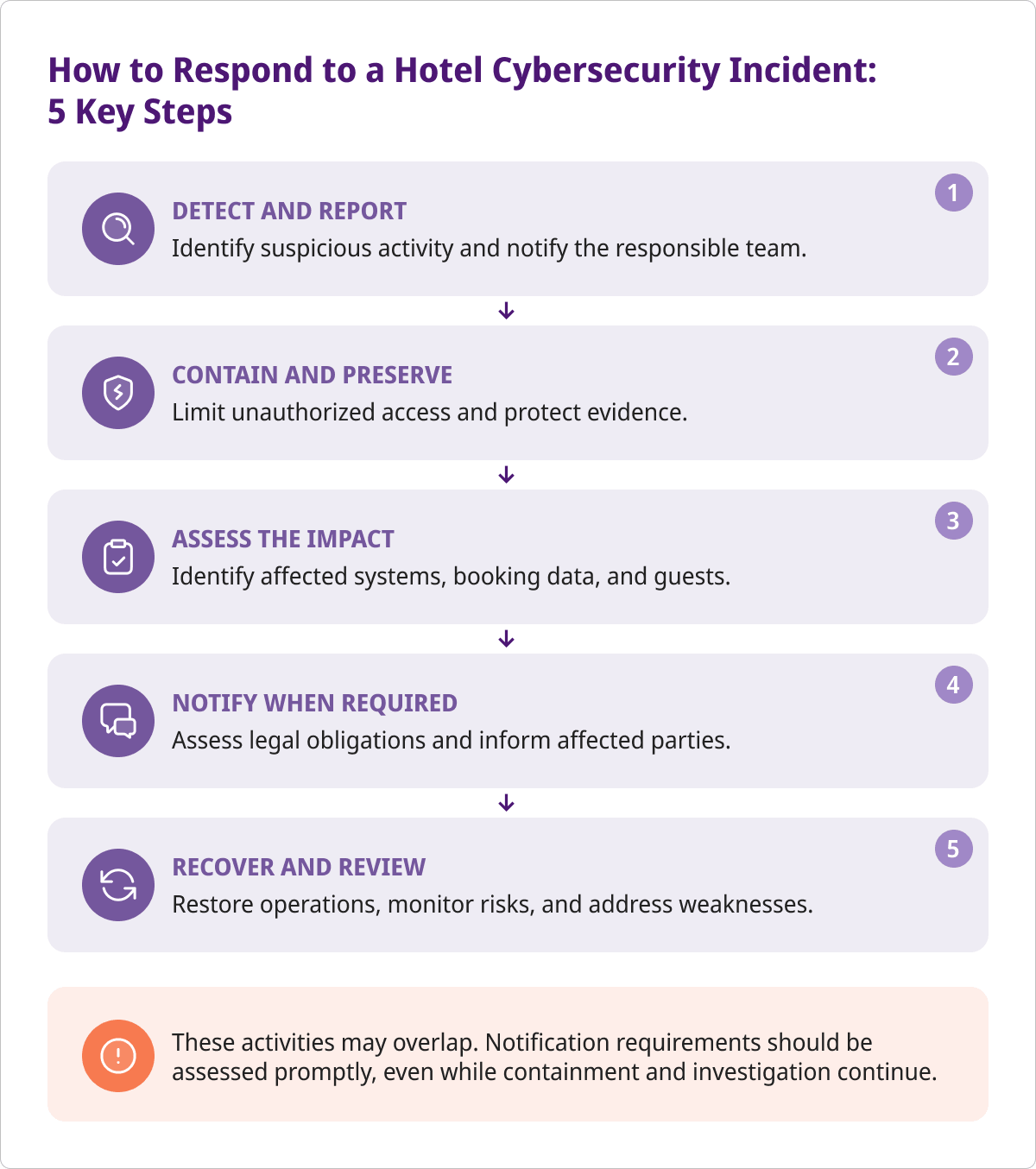
What to do immediately after discovering an incident
The first priority is to limit further damage, preserve evidence, and involve the people responsible for investigating the incident.
Notify the responsible team and document the incident
Employees should report suspected incidents immediately to the hotel's designated IT or security contact. If there is no internal team, contact the provider responsible for the affected system or a qualified security specialist.
Assign someone to coordinate the response, track updates from providers, and keep hotel management informed.
Record when the issue was discovered, which systems or accounts may be involved, and what unusual activity occurred. Preserve suspicious messages, security alerts, and relevant logs. Keep a timeline of actions and decisions throughout the investigation.
Contain the incident
If an employee account may have been compromised, the security team may need to revoke active sessions, reset credentials, and restrict access. Check for unfamiliar accounts, permissions, or email forwarding rules.
If a work computer may be infected with malware, contact IT immediately. A Trojan or other malware could allow attackers to access the device and information available through hotel systems such as the PMS. A security specialist may recommend isolating the computer from the network to prevent further access.
Avoid deleting suspicious files, reinstalling software, or shutting down systems without guidance from the specialists handling the incident. These actions may destroy evidence or unnecessarily disrupt hotel operations.
For incidents involving integrations or cloud systems, coordinate containment with the relevant technology provider.
Contact the relevant technology providers
If booking data may have been exposed, contact the relevant PMS, channel manager, booking engine, OTA, or integration provider through official support or security channels.
Ask them to confirm or investigate:
- Whether there is evidence of unauthorized access.
- Which systems, hotel accounts, and bookings may be affected.
- When the incident began and whether it has been contained.
- What types of guest information may have been exposed.
- What immediate actions the hotel should take.
Providers may not have complete answers immediately. The scope of an incident often becomes clearer as investigators review logs and other evidence.
Keep records of their responses and agree on how updates will be shared. If several providers are involved, establish who is coordinating the investigation.
The fact that a provider processed an affected booking doesn't establish that its systems were the source of the breach.
How to assess the impact of a cybersecurity incident
Once the immediate threat is being contained, assess which guest data and hotel operations may have been affected.
Identify affected systems, data, and guests
Using information from your IT team and technology providers, determine which systems or accounts were accessed and whether data may have been viewed, downloaded, changed, or deleted.
Identify the types of data involved, such as guest names, contact details, booking dates, account credentials, or payment information. Each presents different risks. For example, exposed contact details and booking information may be used for personalized phishing, while stolen credentials could allow further unauthorized access.
Establish the period of possible exposure and identify bookings associated with it. If a provider is involved, request a list of potentially affected properties and bookings.
The scope may change as the investigation progresses. Keep confirmed findings separate from suspected exposure, and don't assume data is safe simply because there is no evidence that it was downloaded.
Assess the operational impact
Check whether staff can access bookings, process payments, manage arrivals and departures, and communicate with guests.
If a critical system is unavailable, activate the hotel's business continuity procedures. Arrange temporary processes for check-in, booking changes, and payments, while keeping any records secure and accessible only to authorized staff.
Record bookings created or modified during the outage so they can be reconciled when normal operations resume.
When and how to notify guests and authorities
Notification obligations should be assessed promptly, even while the technical investigation is still underway.
Determine notification requirements
Data breach notification requirements and deadlines vary by jurisdiction. For example, under the EU General Data Protection Regulation (GDPR), organizations acting as data controllers generally must notify the relevant supervisory authority within 72 hours of becoming aware of a personal data breach, unless the breach is unlikely to pose a risk to individuals' rights and freedoms.
Consult legal or data protection specialists to determine which rules apply to your hotel. Clarify the responsibilities of the hotel and its technology providers, as a provider's reporting obligations don't necessarily remove the hotel's own duties.
Depending on the incident, payment processors, card networks, or other parties may also need to be contacted.
Document notification decisions, including whom to inform and when. Not every suspected incident requires notifying all guests; this depends on the circumstances and applicable legal requirements.
Inform affected guests
When notification is necessary, explain what is known about the incident and what guests should do.
Depending on the findings and legal requirements, include:
- What happened and when it occurred.
- Which types of information may be affected.
- What the hotel has done to address the incident.
- What risks guests should be aware of.
- What steps guests can take and where to get help.
If exposed booking data could be used for fraud, advise guests to verify unexpected requests to confirm bookings, update personal information, or make payments using independently verified hotel contact details.
Keep confirmed information separate from details still under investigation, and explain whether further updates will follow.
Use trusted communication channels. If hotel email accounts may have been compromised, confirm they're secure before sending notifications. When direct contact details aren't available, coordinate with the booking platform.
Make sure front desk and guest service staff know how to respond to questions.
A public security notice can also explain official communication channels, legitimate booking and payment procedures, and where to report suspicious messages. However, it doesn't replace notifications required by law.
What to do after the incident is contained
Containing an incident doesn't necessarily mean the risk has passed. The hotel may still need to restore affected systems, monitor for further misuse of guest data, and address weaknesses identified during the investigation.
Restore systems safely
Before restoring normal operations, work with security specialists to confirm that unauthorized access has been removed and the identified vulnerabilities have been addressed.
Recovery may involve restoring verified backups, rebuilding affected devices, applying security updates, or replacing compromised credentials.
Check that systems and integrations work correctly. Reconcile bookings, room availability, and payments recorded during the outage to identify missing or duplicate entries.
Monitor for further misuse of guest data
Once attackers have copied booking information, fixing the vulnerability doesn't remove the data from their possession. Stolen information may continue to be used for fraud. For more on how criminals use booking details to target guests and how hotels can recognize these scams, read Hotel Phishing Scams: How to Protect Guests and Staff.
Monitor guest reports and coordinate with technology providers and booking platforms. Report fraudulent websites or accounts to the relevant platforms, hosting providers, or authorities.
Criminals may create new fraudulent pages after existing ones are removed, so continued monitoring is important.
If new findings change which guests may have been affected or the risks they face, reassess whether additional notifications or protective measures are necessary.
Review the incident and improve procedures
Review how the incident was detected and handled. Consider whether employees reported suspicious activity promptly, responsibilities were clearly assigned, and technology providers supplied the information needed for the investigation.
Identify gaps in access controls, monitoring, software maintenance, provider agreements, or communication procedures. Assign responsibility for corrective actions and verify that they have been completed.
For practical measures to strengthen your hotel's security after an incident, see Hotel Cybersecurity: How to Protect Your Hotel and Guest Data.
Hotel cybersecurity incident response checklist
Use this checklist to guide your hotel's response to a suspected or confirmed cybersecurity incident.
- Report the incident to the designated IT or security contact.
- Record when and how the incident was discovered, and preserve relevant evidence.
- Contain the threat and secure affected accounts, devices, and integrations.
- Contact relevant technology providers through official channels.
- Identify potentially affected systems, guest data, and bookings.
- Assess legal and regulatory notification requirements promptly.
- Notify affected guests, authorities, and other relevant parties when required.
- Restore systems safely and reconcile bookings and payments recorded during the outage.
- Monitor for further misuse of exposed data.
- Review the incident, address identified weaknesses, and verify corrective actions.
FAQ about hotel data breaches
-
How long does a hotel have to report a data breach under GDPR?
Under GDPR, a data controller generally has 72 hours from becoming aware of a personal data breach to notify the relevant supervisory authority, unless the breach is unlikely to pose a risk to individuals' rights and freedoms. This deadline doesn't automatically apply to guest notifications. Guests generally must be informed without undue delay if the breach is likely to pose a high risk to them. -
Can stolen guest data be recovered or deleted?
Once criminals have copied guest information, the hotel generally cannot retrieve or delete those copies. Even after the security issue has been fixed, the information may still be used for fraud. Hotels should continue monitoring suspicious activity and warn affected guests when appropriate. -
Who is responsible if a hotel's technology provider suffers a data breach?
Responsibility depends on the provider's role, contractual obligations, and applicable data protection laws. A provider may be responsible for investigating and reporting the incident to the hotel, while the hotel may still have its own obligations to notify regulators or guests. -
Does every cybersecurity incident require shutting down hotel systems?
No. The appropriate response depends on which systems are affected and whether the threat is ongoing. A compromised account may require access restrictions, while an infected computer may need network isolation. Shutting down unaffected systems can unnecessarily disrupt hotel operations.